
Photos in this gallery
Vesuvius, Positano, Sorrento · Mar 2026 · 23 photos
Castellammare di Stabia
The town at the base of the Sorrento Peninsula, on the site of ancient Stabiae: the breakwater under evening clouds and the houses with the bay behind.

Castellammare di Stabia, Italy 
Castellammare di Stabia, Italy
Late March on the Bay of Naples: shifting skies, heavy clouds breaking up over the sea and low spring light. The trip starts in Castellammare di Stabia, the town at the base of the Sorrento Peninsula, built on the site of ancient Stabiae, which was also buried in the eruption of 79 AD. In the evening, the stone breakwater points out to sea under a vault of backlit cloud; by day, houses climb the hillside with the bay and Naples in the distance.
Pompeii
The ruins of the Roman town buried in 79 AD and its Large Theater, with stone seating set in a half circle.

Pompeii, Pompei, Italy 
Pompeii, Pompei, Italy
Positano
The village climbs the steep hillside in tiers, its ocher and pink houses stacked above the beach.

Positano, Italy
A few miles away lies Pompeii: the Roman town covered by the ash of Vesuvius in 79 AD and excavated from the 18th century on, with its streets, house walls and the Large Theater, its stone seating set in a half circle. The archaeological areas of Pompeii, Herculaneum and Torre Annunziata are listed together as a UNESCO World Heritage Site.
Spiaggia Grande
Positano's main beach of dark sand and pebbles, overlooked by the majolica dome of Santa Maria Assunta.

Spiaggia Grande, Positano, Italy 
Spiaggia Grande, Positano, Italy
Amalfi Coast
Between Praiano and Amalfi the coast road runs above the cliffs, and at Conca dei Marini a headland with a watchtower juts into the sea. In Amalfi, the striped facade of Sant'Andrea Cathedral.

Amalfi Coast, Praiano, Italy 
Amalfi Coast, Praiano, Italy 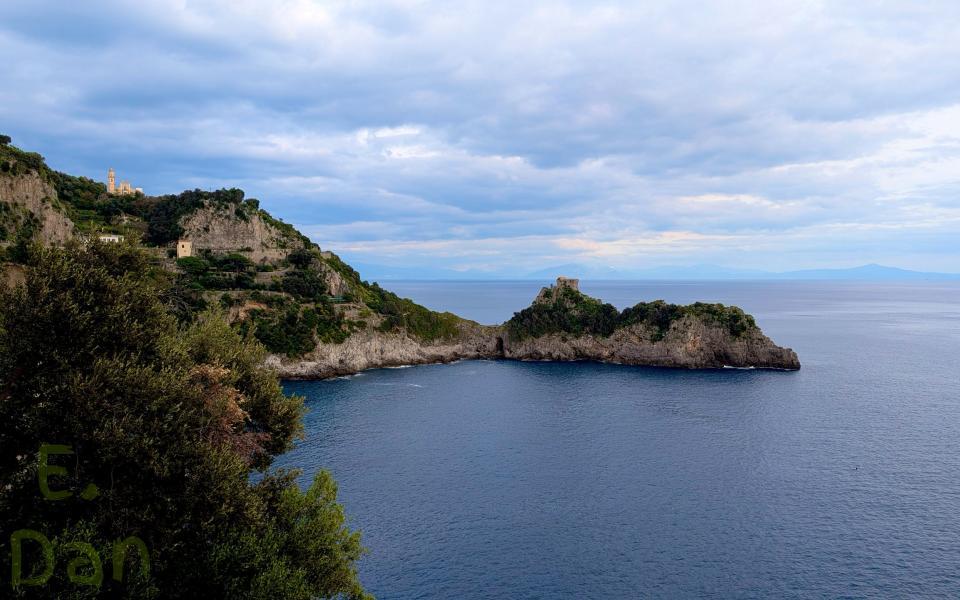
Amalfi Coast, Conca dei Marini, Italy 
Amalfi Coast, Conca dei Marini, Italy
Amalfi Cathedral
Amalfi's Cathedral of Sant'Andrea towers over the town square at the top of a wide staircase, with its striped, mosaic-covered facade.

Amalfi Cathedral, Amalfi, Italy
March 29 is spent on the Amalfi Coast, a UNESCO World Heritage Site since 1997 as a cultural landscape of villages, terraces and roads built into the slope. Positano steps down to the Spiaggia Grande beach in shades of ocher and pink, with the majolica dome of Santa Maria Assunta above the shore. Farther on, at Praiano and Conca dei Marini, the coast road clings to the cliffs above deep water, and a headland with an old watchtower juts into the sea. At the end lies Amalfi, once a maritime republic, with the striped facade of Sant'Andrea Cathedral rising from a broad staircase and houses pressed against the rock above the quay.
Amalfi
The harbor of the former maritime republic, its houses pressed against the rock above the quay.

Amalfi, Italy 
Amalfi, Italy
Vesuvius
The crater of the volcano, with layered walls and fumaroles, and the Bay of Naples seen from its slopes.

Vesuvius, Ercolano, Italy 
Vesuvius, Ercolano, Italy 
Vesuvius, Ercolano, Italy 
Vesuvius, Ercolano, Italy 
Vesuvius, Ercolano, Italy
The next day brings Vesuvius, about 1,281 m high, the only active volcano on the European mainland, last erupting in 1944. The road climbs through woods and lava fields to just below the crater, and from the rim you look into a deep funnel of layered rock with fumaroles still letting off steam; to the west, the whole bay, with Naples spread out at the foot of the mountain. In the evening, in Sorrento, the buildings on the tuff cliffs light up above the sea while the lights of the towns across the bay string out along the shore.
Sorrento
Evening on the town's tuff cliffs, with a dark sea and the lights of the bay in the distance.

Sorrento, Italy
Piazza del Plebiscito
The great square in the center of Naples, with its curved colonnade and the dome of San Francesco di Paola.

Piazza del Plebiscito, Napoli, Italy
Galleria Umberto I
The shopping arcade in the center of Naples, opened in the late 19th century under a large iron-and-glass dome.

Galleria Umberto I, Napoli, Italy
The last day is in Naples. Castel Nuovo, the 13th-century Angevin fortress by the harbor, has round towers and Vesuvius on the horizon; from beside it you can see the dome of the Galleria Umberto I and, on the hill, Castel Sant'Elmo. Piazza del Plebiscito opens out before the curved colonnade of the Basilica of San Francesco di Paola. The historic center of Naples has been a UNESCO World Heritage Site since 1995.
Castel Nuovo
The 13th-century Angevin fortress by the harbor, with Vesuvius on the horizon; beside it, the dome of the Galleria Umberto I and Castel Sant'Elmo on the hill.

Castel Nuovo, Napoli, Italy