
Bosphorus Bridge

← Previous photo: Çırağan Palace Next photo: Bosphorus Bridge →
All 34 photos in Turkey 2023
Troy, Pamukkale and Istanbul · Jun 2023 · 34 photos
Çanakkale
The waterfront on the Dardanelles and the striped arcades around the courtyard of a large mosque in Çanakkale.

Çanakkale, Turkey 
Çanakkale, Turkey 
Çanakkale, Turkey
Four days in early June 2023 link three landmarks of Turkey: the Dardanelles and Troy, the white terraces of Pamukkale, and Istanbul on the shores of the Bosphorus. The photos follow the route from the northwest into inland Anatolia and then to the city between Europe and Asia, and the light changes along the way: clear skies on the coast, summer clouds over the uplands around Pamukkale, rain and leaden skies in Istanbul.
The Trojan Horse
The wooden horse on the Çanakkale waterfront, built for the 2004 film Troy and later given to the city.

The Trojan Horse, Çanakkale, Turkey
Troy
The archaeological site of Troy, a UNESCO site: stone walls from settlements layered over nearly four thousand years.

Troy, Çanakkale, Turkey 
Troy, Çanakkale, Turkey
Çanakkale lies on the Asian shore of the Dardanelles. Its waterfront holds the wooden horse built for the 2004 film Troy and later given to the city, and in town stands a large new mosque with a courtyard framed by striped arches. About 30 kilometers to the southwest, the archaeological site of Troy, on the UNESCO World Heritage List since 1998, preserves the remains of settlements layered over nearly four thousand years; the photos show its stone walls and the wooden walkways that cross the excavations.
Pamukkale
Pamukkale's travertine terraces, laid down by mineral-rich hot springs, with turquoise pools above the plain. The chapter also gathers a few pictures taken elsewhere on the trip.

Pamukkale, Turkey 
Pamukkale, Turkey 
Pamukkale, Turkey 
Pamukkale, Turkey 
Pamukkale, Turkey 
Pamukkale, Turkey 
Pamukkale, Turkey 
Pamukkale, Turkey
Hierapolis
The ancient city of Hierapolis above the white terraces, with paved streets, ruins and gardens among the stones.

Hierapolis, Pamukkale, Turkey
Hagia Sophia
Hagia Sophia, built in the 6th century under Justinian, its dome and minarets under a rainy sky.

Hagia Sophia, Istanbul, Turkey 
Hagia Sophia, Istanbul, Turkey 
Hagia Sophia, Istanbul, Turkey
Pamukkale, whose name means cotton castle, is a hillside covered in travertine: thermal springs rich in calcium carbonate have built up white terraces and pools filled with turquoise water that visitors wade through barefoot. Above them spread the ruins of the ancient city of Hierapolis, with paved streets, walls and a Roman theater cut into the slope. Hierapolis-Pamukkale has been a UNESCO site since 1988.
Topkapı Palace
Topkapı Palace, home of the Ottoman sultans: the Imperial Gate, courtyards of cypress and plane trees, tiled pavilions and views of the Bosphorus.

Topkapı Palace, Istanbul, Turkey 
Topkapı Palace, Istanbul, Turkey 
Topkapı Palace, Istanbul, Turkey 
Topkapı Palace, Istanbul, Turkey 
Topkapı Palace, Istanbul, Turkey 
Topkapı Palace, Istanbul, Turkey 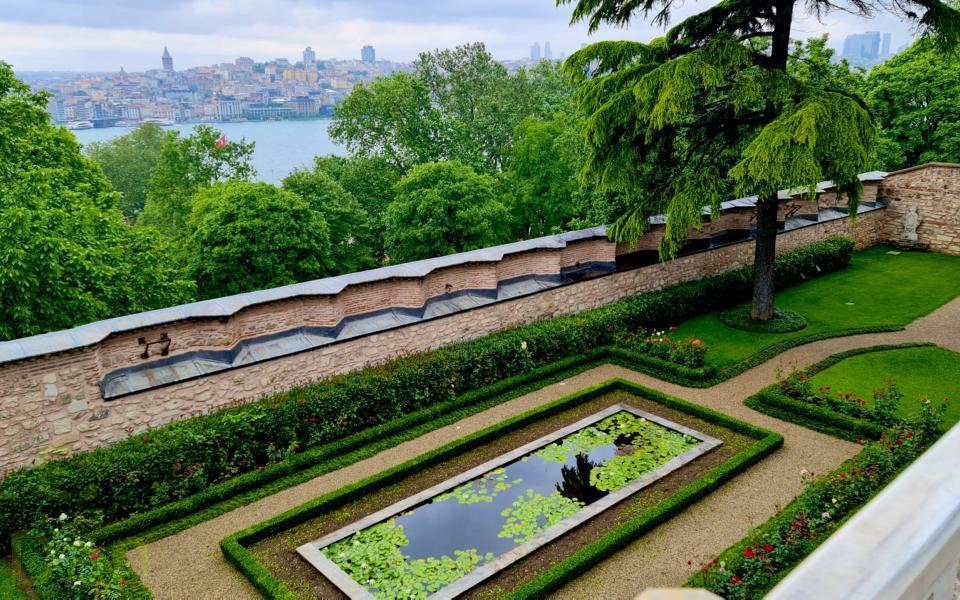
Topkapı Palace, Istanbul, Turkey 
Topkapı Palace, Istanbul, Turkey 
Topkapı Palace, Istanbul, Turkey
Istanbul
A view from Istanbul's old city across the Golden Horn to the Galata Tower and the districts on the far shore.

Istanbul, Turkey
The last day is in Istanbul, under an overcast sky, with umbrellas open in the squares between the monuments. Hagia Sophia, built in its present form in the 6th century under Emperor Justinian, stands close to Topkapı Palace, home of the Ottoman sultans for nearly four centuries. The photos from the palace show the Imperial Gate, courtyards with cypresses and plane trees, pavilions faced with blue tiles and the view across the Golden Horn to the Galata Tower. The city's historic areas have been on the UNESCO list since 1985.
Dolmabahçe Palace
The long facade of Dolmabahçe Palace, from the mid-19th century, seen from the waters of the Bosphorus.

Dolmabahçe Palace, Istanbul, Turkey
The Bosphorus
The Bosphorus at night from a boat, with the lights of the European shore reflected in the water.

The Bosphorus, Istanbul, Turkey 
The Bosphorus, Istanbul, Turkey
Çırağan Palace
Çırağan Palace, lit up at night on the European shore of the Bosphorus.

Çırağan Palace, Istanbul, Turkey
In the evening, from a boat on the Bosphorus, come the palaces of the European shore: Dolmabahçe, built in the mid-19th century when it took over from Topkapı as the sultans' residence, and Çırağan, lit up on the water. The album ends with the suspension bridge opened in 1973, the first to join Europe and Asia across the strait, its cables glowing in color above the dark water.
Bosphorus Bridge
The suspension bridge opened in 1973, the first to join Europe and Asia across the Bosphorus, its cables lit in color.

Bosphorus Bridge, Istanbul, Turkey 
Bosphorus Bridge, Istanbul, Turkey